
Why Your Manufacturing Website Isn’t Ranking on Google
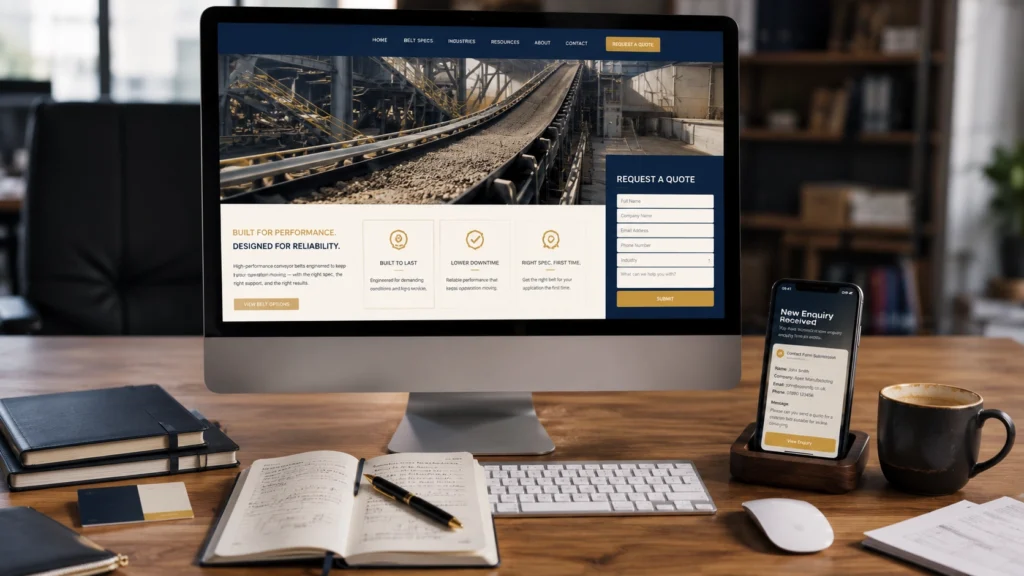
Why good manufacturing websites still fail to rank
Try this: type your own company name into Google. Feels good when you’re first, doesn’t it? Now search for what you actually sell instead. Most manufacturing business owners who try that are in for a surprise. Competitors show up. Distributors show up. Sometimes a directory listing nobody’s touched since 2016 outranks the homepage that just cost a few thousand pounds to redesign.
We hear this frustration constantly. The site looks the part. The products are solid. And the phone still doesn’t ring the way it should, so the sales team keeps leaning on trade shows, referrals, and cold outreach because the website isn’t pulling its weight.
Usually this isn’t some mystery buried in Google’s algorithm. Manufacturing websites tend to struggle for a small, predictable set of reasons, and fixing most of them doesn’t mean tearing the site down and starting over. Below is why it happens, the mistakes we run into over and over, and what to actually do about them.
Why ranking matters more than most manufacturers realise
For a manufacturer, search visibility isn’t something to glance at once a quarter. It’s one of the only channels where someone who already has a problem, and is already hunting for a fix, lands in front of you at the exact moment they’re ready to act.
Compare that to a trade show, where you’re paying for attention from people who may or may not need anything you make. Or referrals, which are great when they happen but impossible to switch on when you actually need one. Search works differently. When an engineer types “stainless steel enclosure manufacturer UK,” or a procurement manager searches a specific tolerance or certification, they’re further along than almost anyone else you’ll reach that day. They’re not browsing. They’re evaluating suppliers.
Miss those searches and you’re not just losing some traffic. You’re handing a qualified, ready-to-buy prospect straight to whichever competitor happens to show up instead. Industrial buying cycles run long and depend on trust, so losing that first moment of visibility often costs the whole opportunity, not just one sale. Whoever the buyer finds first tends to make the shortlist. And shortlists in this world are short.
There’s a second problem underneath all this: rankings compound. A competitor who’s spent two years steadily building out their site isn’t just ahead of you today. They’re pulling further away every month the gap goes unaddressed.
This isn’t a minor gap either. Ahrefs’ analysis of search results found that the top three organic results capture 68.7% of all clicks, while barely 0.78% of searchers ever bother clicking through to page two. If you’re not on that first page, you are, for practical purposes, invisible to the buyer doing the searching.
Common Mistakes
Most manufacturing websites fall into the same handful of traps.
They get built to look impressive rather than to be found. A lot of industrial companies commission a website the way they’d commission a brochure, wanting it to look credible and reflect the brand well. Fair enough. But it means decisions get made around layout instead of what buyers actually type into Google, and you end up with a site that impresses whoever’s already arrived while doing nothing to pull anyone else in.
Product pages are often paper-thin. “High-Quality Injection Moulding Services,” two sentences, a stock photo. That’s not much for Google to work with, and it’s even less for an engineer trying to figure out whether you can hit their tolerance. If the specific material, certification, or application never appears on the page, that search will never find you.
Then there’s the PDF problem, which hits manufacturing harder than almost any other industry. Datasheets, specs, entire catalogues, all uploaded as static PDFs instead of built out as real pages. Google can index a PDF, sure, but it won’t rank anywhere near as reliably as a proper page, and you lose all the internal linking and formatting that actually helps a page perform. Best technical content on the site, and it’s basically invisible to search.
Take a fabricator making custom brackets and enclosures: their full specification range only exists in a 40-page PDF catalogue uploaded a few years ago. A buyer searching for “18-gauge steel enclosure IP65 rated” will never find them, because that exact phrase only appears inside a PDF Google barely indexes, while a competitor with the same information built into an actual product page shows up instantly.
Or a precision machining shop whose homepage proudly lists “ISO 9001 certified, five decades of experience,” but whose service pages never mention the specific materials, tolerances, or industries they work in. An engineer searching for “5-axis CNC machining aerospace aluminium” has no way of knowing this shop does exactly that, because the words never appear anywhere on the site.
A lot of sites simply don’t have enough content. Ten pages describing what the company does puts a hard ceiling on how much traffic you’ll ever pull in, however polished those ten pages are. Buyers ask far more than that: how something’s made, how to choose between materials, what a process actually costs, how long lead times run. None of that exists anywhere on the site, so none of those searches have anywhere to land.
Technical debt piles up quietly too. Slow load times, missing title tags, broken internal links, no mobile optimisation, near-duplicate product pages. Nothing dramatic on its own, but manufacturing sites accumulate this over years of ad hoc changes, and together it drags everything else down.
Authority is another blind spot most manufacturers never touch. Google weighs how trustworthy a site appears, partly based on who else links to it. Even genuinely good content struggles to rank when the domain itself doesn’t carry much weight yet.
Local versus national intent gets mixed up constantly, too. A company shipping nationwide but only optimising for its head office town, or the reverse, ends up competing in the wrong results entirely and losing ground on both fronts.
And sites get optimised once, then left alone for years. We regularly find websites that had a proper SEO push back in 2021 or 2022 and haven’t been touched since. Algorithms shift.
Competitors publish new content. Buyer language changes. A site nobody maintains loses ground even when nothing on it has technically broken.
Practical Advice
None of this needs starting from scratch. Roughly in order of impact:
Start with your core product and service pages, since they carry the most commercial intent. Each one needs to explain what the product or service actually is, who it’s for, the materials or tolerances involved, relevant certifications, typical applications, and what happens after someone enquires. Write for the person who already knows roughly what they need and is checking whether you can deliver it. Real depth naturally runs longer than the two-paragraph version most competitors have. Don’t force brevity where it isn’t earned.
Turn your PDFs into actual pages. This is often the single biggest lever a manufacturer can pull. Take your best datasheets and catalogue entries and rebuild them as pages, keeping the PDF available as a download for anyone who still wants it. This one change alone can unlock rankings that were previously invisible.
Build supporting content around the questions buyers actually ask. What comes up on a sales call? What does a technical buyer need to understand before trusting a new supplier? Content that answers this in real depth, not 300-word filler, does two things: it captures searches your core pages never will, and it builds the kind of topical authority that lifts everything else on the site too.
Fix the technical basics. Run the site through Google Search Console or a basic audit tool to catch broken links, missing metadata, slow pages, mobile issues. Not glamorous work, but it removes the ceiling on everything else you do.
Link your pages to each other on purpose. Every article or product page should point to related pages using natural, descriptive text. It helps visitors find what they’re after, and it helps Google understand how your topics connect, which lifts rankings across the whole site rather than page by page.
Be patient without going passive. A site with real structural gaps usually needs several months before you see movement, longer for the most competitive terms. That’s normal.
What matters is the compounding: pages you publish and improve this quarter keep paying off years down the line, in a way a trade show stand never does once the budget runs out.
Track what actually matters. Rankings on their own mean less than enquiries generated from organic search. Set up basic tracking so you can see which pages are producing leads, not just traffic, and put more effort behind whatever’s working.
Treat it as an ongoing programme rather than a project with an end date. The businesses that get the strongest, most durable results keep publishing, keep refreshing older content, and keep half an eye on what’s shifting in search. A quarterly look at what’s ranking, what’s slipping, and what competitors have started doing well keeps the momentum going, instead of letting early gains quietly erode.
Key Takeaways
Frequently Asked Questions
Call To Action
If you read through this and spotted your own website in more than one place, you’re not alone, and none of it is hard to fix once you know where to start.
We help manufacturing and industrial companies turn their websites into an actual source of enquiries instead of an online brochure. Get in touch with the team at Paull Digital
We’ll take a straightforward look at where your site stands and what would move the needle fastest.